Walkthrough


'Peculiar' Creature With See-through Body And 'striking' Eyes Found In Peru Forest
Researchers discovered a new and "peculiar" amphibian species while traipsing through a swampy forest in Peru.
The newfound creature is a type of glass frog, meaning part of its body is transparent, making visible some of its internal organs, according to a study published on May 16 in the journal Evolutionary Systematics.
Researchers came across two specimens of the species while traveling near a riverbank in the foothills of the Andes Mountains in 2019.
Guided by torchlights and headlamps, they spotted the creatures — both males — perched on leaves and making high-pitched chirping noises in the rain.
The new species, named Chimerella mira, was discovered in the rainforest at night by researchers with headlamps.
The frogs were captured, euthanized and taken to a lab for further study. After closer observation and molecular analysis, it was determined that the frogs were members of a previously undocumented species.
It was named Chimerella mira after the Latin word for "surprising" because upon first observation, researchers confused the frogs with another species.
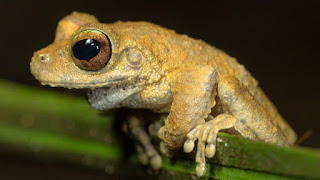
Only the third known species in its genus, named Chimerella, the yellow-green frog is distinguished by its "striking" eye color and unique mating call.
Chimerella mira's silvery-white iris sets it apart from the other related frogs, researchers affiliated with institutions in Peru and Germany said.
"Although these differences may appear negligibly small, iris colouration has proven to be a very reliable diagnostic character in many groups of frogs to distinguish among species," researchers said.
Additionally, the newfound frog produces a mating call consisting of multi-pulsed notes known as "Trii" calls, while its closest relative makes single-pulsed "Tic" calls, researchers said. Though subtle, the difference is also indicative of species separation.
Much else about Chimerella mira, including its population size, range and reproductive habits, remains unknown.
"Our findings demonstrate the need for future research to evaluate the taxonomic status of numerous populations of glassfrogs, particularly in Peru, where they remain markedly understudied," researchers concluded.
Story continues
There are 163 known species of glass frogs, allocated to a dozen genuses.
The frogs can turn their transparency on and off, and typically use it as a form of camouflage when they are vulnerable, according to a study published in the journal Science in 2022.
To become partially see-through, they conceal most of their blood cells by packing them into their liver, the study found.
'Mini-kangaroos' — who love peanut butter — thrive after reintroduction to Australia
See the dramatic moment a falcon snatched a puffin out of the sky. 'Absolutely nuts'
Fire ravaged this Spanish building over a millennia ago. See the coins that survived
Mistaken Identity: Colombian Glass Frog Actually New To Science
Luisa Fernanda Arcila-Pérez in the field with a glass frog.
David JulianAfter years of diligent work in the forests of Colombia and museums overseas, there is officially a new member in the family of frogs called the Centrolenidae, more commonly known as Glass Frogs.
Colombia has dozens of species of Glass Frog and they even feature on the latest 500 Colombian peso coin, but there is still more study to be done to identify the many knowledge gaps, for example, determining which physical characteristics are important for identifying different species.
Luisa Fernanda Arcila-Pérez, a biologist from Colombia's Universidad del Quindío, currently associated working with the Evolution Ecology and Conservation (EECO) research group and one of co-authors of the paper about the new frog says that although the frog was first identified in 2016, it was a five year process to collect physical data of both adults and tadpoles, the distinctiveness of their calls and genetic sequences.
"These data describe a new species of glass frog (Nymphargus pijao sp. Nov.) endemic to Colombia that had been previously missasigned to Nymphargus griffithsi," she says.
In the paper "A multidisciplinary approach reveals a new species of glassfrog from Colombia (Anura: Centrolenidae: Nymphargus)" published in the journal Zootaxa in April of 2023, the researchers showed a low-cost method implemented in the field to rear tadpoles of the new species, which was crucial to the project.
"This research allows species to be classified for their correct identification and monitoring of their populations, which in turn can contribute to the management and conservation of biodiversity," Arcila-Pérez says, adding that the description of a new species can increase the understanding and appreciation of biodiversity by the local communities.
Luisa Fernanda Arcila-Pérez
Mariana MontillaArcila-Pérez grew up in Armenia, a city at the heart of Colombia's coffee region and says her connection with frogs started when she was very young, visiting her grandparents in the countryside .
"I heard very loud sounds, but I did not know at the time by whom these sounds were emitted... Today, I cherish those moments and spend my life researching the call of the frogs, which are animals that have been rejected by people for years," she says.
Later on, in first year university, an assignment about frog reproduction cemented her interest.
"In one species, some adult frogs ingest the eggs in a special sac in their stomach and later vomit them as small and developed frogs," Arcila-Pérez says, "This was fascinating to me and from that moment I decided to focus all my work on learning about frogs."
Arcila-Pérez says her experiences in the US, French Guiana, Panama and other parts of the world have developed her as a professional, but she believes that Global South scientists have many special qualities that they bring to their work.
"As a Latin American researcher, I believe that scientists from the Global South are passionate about research," Arcila-Pérez says, adding that they have many skills that make them much stronger in science, such as tenacity, passion, and a resourcefulness born of the economic limitations in science that several countries have.
"I think that these qualities have allowed us to carry out high level research and to be published in national and international journals of higher impact."
Another species of Colombian Glass frog (Centrolene, Centrolenidae) in Biogeographic Choco, ... [+] Buenaventura, Colombia, showing the transparent skin that earned their name.
Universal Images Group via Getty ImagesAnother Colombian researching frogs is Bibiana Rojas.
MORE FROM FORBESWhat Sparked This Colombian's Passion? Poison Frogs At An Airport!By Andrew WightShe says her life changed forever when she got to meet a poison frog in real life.

Comments
Post a Comment